FINCAPES Brings Evidence, Policy, and Lived Experience into the Disaster Resilience Conversation at IDRiM 2026
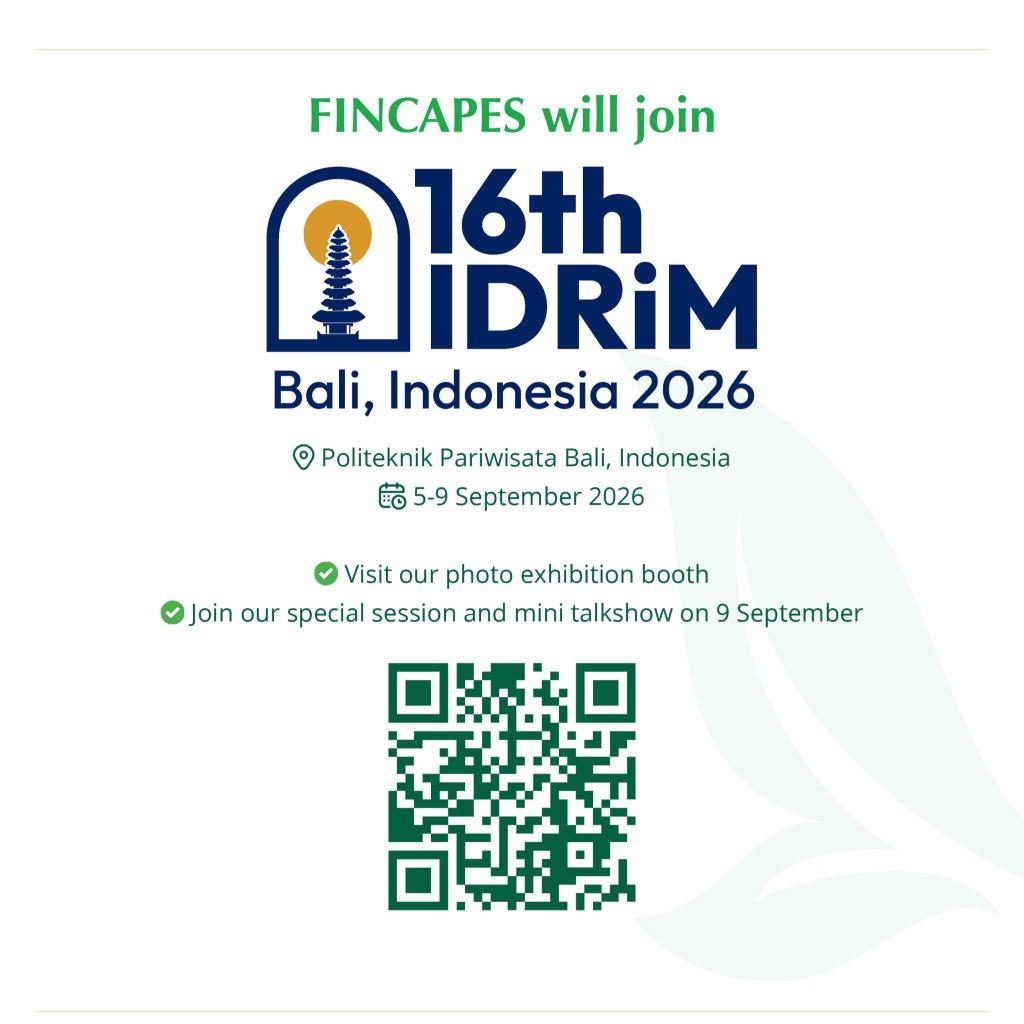
How do we better understand what disasters cost and translate that understanding into decisions that strengthen resilience before the next disaster occurs?
At the IDRiM Conference 2026 in Bali on 9 September, FINCAPES will bring this question into focus through two complementary sessions examining disaster risk from different but interconnected perspectives.
Disaster losses are often expressed through numbers: people affected, homes and infrastructure damaged, economic losses, and the cost of recovery. Advances in flood modelling, remote sensing, and actuarial analysis are making it increasingly possible to understand where risks are concentrated and estimate the financial consequences of future disasters.
Generating the numbers is only part of the challenge. Translating them into decisions is another. At the same time, aggregate loss figures may not fully capture how disasters are experienced differently across communities, including disruptions to livelihoods, care responsibilities, mobility, safety, access to services, and other consequences that can be difficult to quantify.
Through a special session and a mini talkshow accompanied by a photo exhibition, FINCAPES will explore both sides of this challenge: how evidence can help governments better understand and finance disaster risk, and how the experiences and vulnerabilities behind the numbers can remain visible in the decisions that follow.
From Flood Risk Evidence to Disaster Risk Financing Policy
- 📅 Rabu, 9 September 2026
- 📍 IDRiM Conference 2026, Bali
- Venue: Aula Joop Ave, 10.30-12.00 WITA
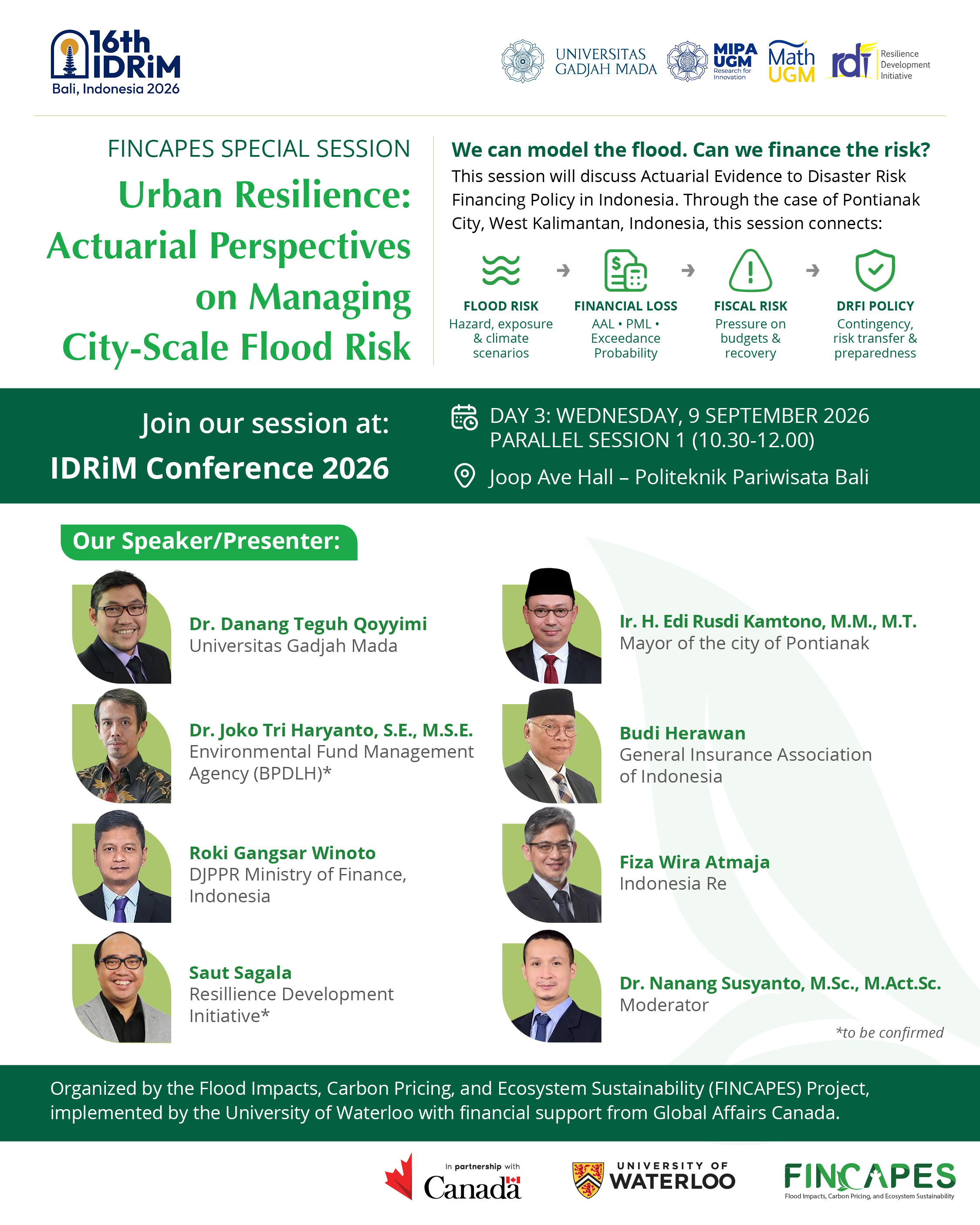
The first discussion, “Urban Resilience: From Actuarial Evidence to Disaster Risk Financing Policy in Indonesia,”focuses on a critical transition in disaster risk management: moving from understanding physical flood hazards to understanding their financial and fiscal implications.
Using Pontianak, West Kalimantan, as a case study, the session will bring together two complementary streams of evidence.
The FINCAPES Disaster Risk Financing and Insurance (DRFI) Study examines how flood risk can be situated within Indonesia’s broader disaster risk financing and fiscal architecture. Complementing this, the UGM Actuarial Flood Loss and Damage Study translates flood scenarios into quantitative financial parameters, including Average Annual Loss (AAL), Probable Maximum Loss (PML), and Exceedance Probability, providing an evidence base that can inform discussions around contingency financing, insurance pricing, risk transfer, and disaster recovery budgets.
By connecting actuarial research with government and policy perspectives, the session will examine institutional, fiscal, and governance pathways for operationalizing DRFI recommendations. It will also explore whether lessons from Pontianak could inform urban fiscal resilience planning in other flood-exposed cities across Indonesia and the wider region.
Beyond the Numbers: What Are We Missing When We Calculate Loss and Damage?
- 📅 Rabu, 9 September 2026
- 📍 IDRiM Conference 2026, Bali
- Venue: Aula Joop Ave, 14.30-16.00 WITA
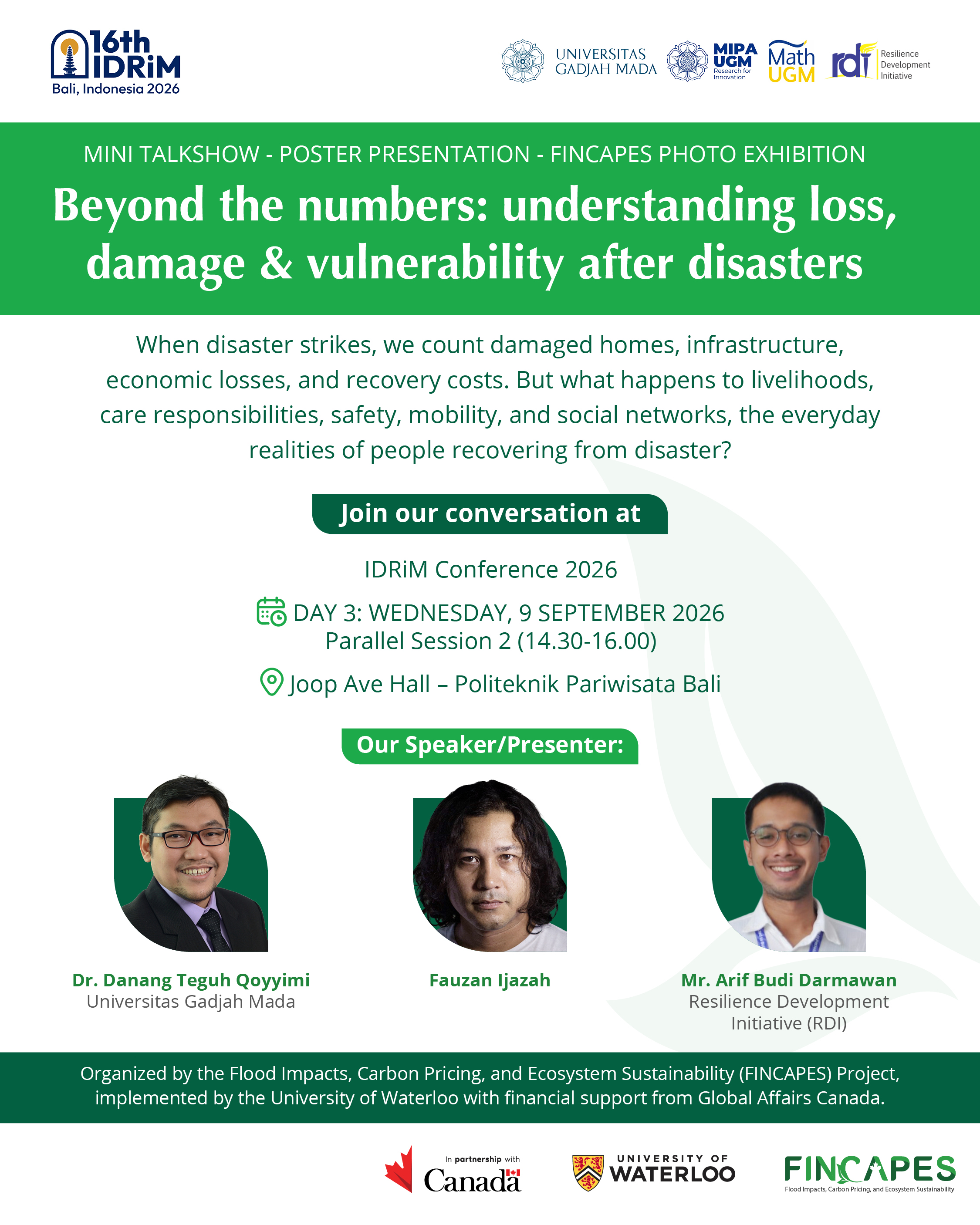
The second conversation shifts the lens from financial calculations to the people and experiences behind them. The mini talkshow, “Beyond the Numbers: Understanding Loss, Damage & Vulnerability After Disasters,” begins with a deceptively simple question: When we calculate loss and damage after a disaster, what are we counting, and who or what may still be missing from that calculation?
Presented alongside a FINCAPES photo exhibition, the conversation brings together three complementary perspectives: actuarial analysis, visual storytelling, and gender equality and social inclusion.
The visual storytelling draws on photographs documenting communities affected by the cyclone-related floods and landslides in Aceh and Sumatra in 2025. The images provide a different form of evidence, revealing how disaster impacts unfold in homes, neighbourhoods, livelihoods, public spaces, and everyday life.
The discussion will consider how factors such as gender, age, socio-economic circumstances, disability, care responsibilities, and access to services can shape how people experience disasters and recovery. The purpose is to ask how different forms of evidence can complement one another, contributing to a fuller understanding of loss, damage, vulnerability, and resilience.
About FINCAPES
The Flood Impacts, Carbon Pricing, and Ecosystem Sustainability (FINCAPES) Project is a 5.5-year initiative implemented by the University of Waterloo with financial support from Global Affairs Canada. FINCAPES works with Indonesian government institutions, universities, private-sector actors, and communities to strengthen climate resilience, biodiversity conservation, and sustainable development.